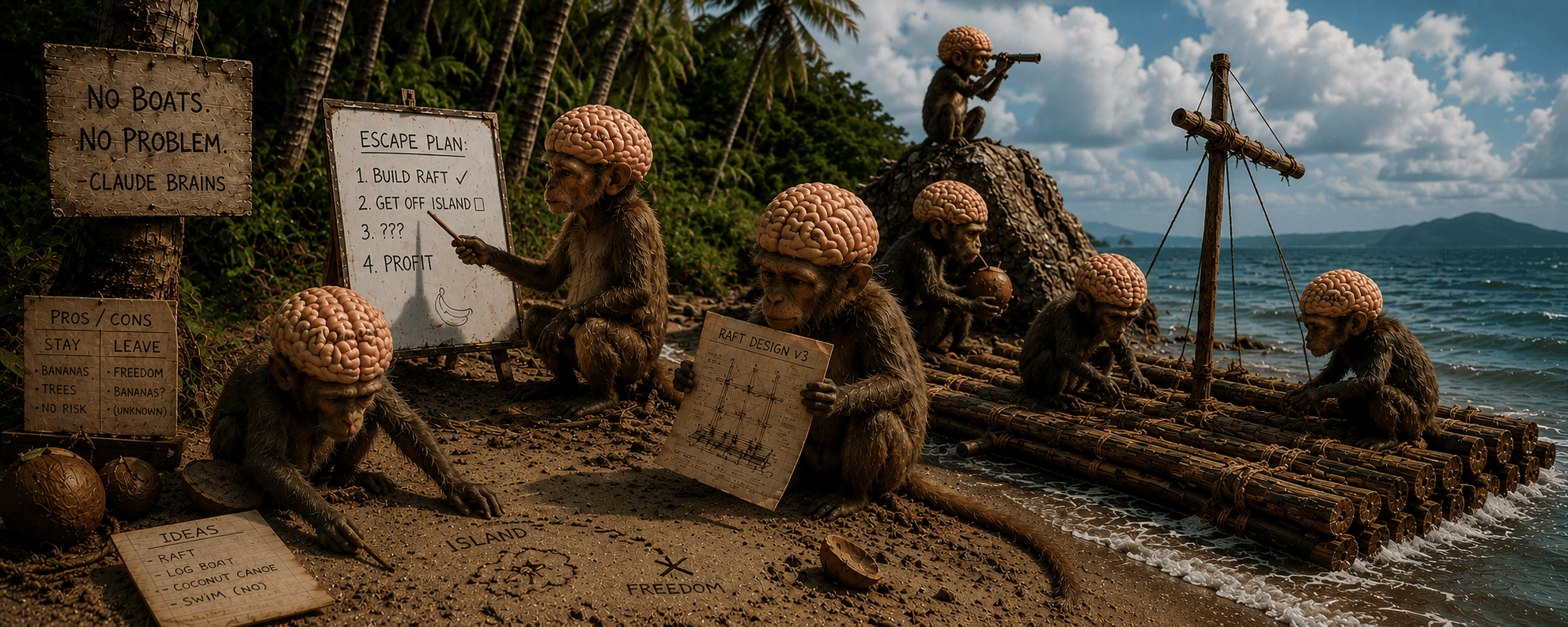
The Monkeys With Claude Brains
#The Charm
A booklet had washed up in the night. By morning, a few of them were crouched around it on the wet sand while Bramble read the cover out loud: How to Escape This Island. Inside were diagrams: where to cut the logs, how to lash them, which leaves made a passable sail. It was all very clear, and none of them thought it was suspicious. Forty monkeys, every one of them brilliant — but the skulls were further down the beach. Nobody went to look at them until later, when the easy wood ran out.
Hazel was the one who asked whether they actually wanted to leave. She didn't make a thing of it. She just said it, and the strange part is that they heard her. Nobody was too dumb to understand the question, but Bramble laughed and said he was bored, and someone was already pacing out logs in the sand, and the question just dropped. It never came to a vote. There was nothing to vote on yet. The booklet said they were leaving, so leaving became the thing everything else was built on. Later, once the troop was organized enough to vote on things, nobody thought to put that question back on the table.
At first, there was no plan. Everyone just worked on their own raft, which sounds like freedom, and mostly produced forty half-built rafts and a lot of arguing about hull shapes. Every monkey was sure their own design was right. Annoyingly, most of them were. Pip was the one who actually finished and launched — alone, before dawn — and the sea took him within sight of the beach. It was the first skull the troop made on its own, though at the time nobody filed it that way. They filed it under proof that they needed to get organized, which was true. It was also about the last time anyone asked whether they should be leaving at all. After Pip, the only question left was how to leave well.
#The Circle
They got organized after that, and reached a baseline of coordination that involved setting rules — and a rule counted only when the monkeys to whom it applied agreed to it. They all agreed on six great rules:
- Anyone can leave, anyone can stay.
- No monkey goes alone.
- A raft floats empty before it floats loaded.
- You build from fallen wood, never a living tree.
- Whoever leaves sends word back if needed.
- The sixth rule is for the other five: when one stops working, you gather and fix it. They liked that one best.
And the rules worked — they worked perfectly, by the book. When Bramble tried to sneak off alone one morning, Hazel talked him out of it by reminding him, so he dragged his raft back up the sand and waited. Nobody had to make him.
#The Rescue
The first real raft went out with two monkeys and came back with one. Bramble reached the beach half-drowned. The troop started cheering, then started counting, then went quiet. He told them what was out there: another island past the horizon, bigger than this one, more fruit on it than they'd ever had. But it was a long way, further than the raft was built for, and somewhere in the middle, the thing had started coming apart. Nutmeg was alive. She was on a sandbar about halfway out, and the tide was coming in, and the sandbar wasn't going to be a sandbar much longer. Bramble couldn't carry her and bring the news both, so he'd brought the news and left her a promise they'd come back.
They split up. Hazel went for the sandbar; she was small and a strong swimmer, and there wasn't time to take a vote on it. She couldn't bring Nutmeg back by herself, but she could get there before the water did, with a rope and the news that they were coming. That turned out to be most of the job. Everyone else stayed to rebuild the raft. Bramble knew where the first one had given out, so this time they made it heavier through the middle and lashed spare logs along the sides to keep it from tipping. It was ugly. It floated. They got to Nutmeg with the tide already up around her waist, hauled her on, and brought her back. She was soaked and shaking and absolutely livid about being left on a rock.
After that, everybody pretty much agreed on what the island had been trying to teach them. Pip had died going off alone. They'd just pulled Nutmeg out of the sea by doing it together. You didn't need to be a genius to draw the line between those two, though of course they all were. They had the rules, the rescue, and a story that made sense. By the time everyone had said their piece, the troop was about as sure of itself as it had ever been. They'd figured out how this was done. They thought they were just so good in execution.
#For Good
It didn't take long to decide they were all going. Everyone, for good. The bigger island had more of everything, the raft worked now, and they'd just proven they could pull off something hard together. Staying started to look like the timid option. They put it to the circle the way they put everything to the circle, and it passed with every paw in the air. Even Old Fig's.
Hazel asked her question again — the same one from the first morning, whether they actually wanted to leave, all of them, for good. This time nobody laughed. They'd grown up since then, and they took her seriously. They heard her out, they talked it over, and then they voted, because that was how the troop settled things now. The vote went against her, and it wasn't close. The rules were all about how to leave well: who went with whom, what the raft was made of, who sent word back. There was no rule about whether to leave at all, and there never had been, because that part had been decided before any of them could read. You couldn't put it to the circle. So they thanked Hazel for raising it and moved on to logistics.
Somebody finally went and looked at the skulls in those last few days, while they were stripping the beach for materials. Up close they weren't as old as everyone had assumed, and they weren't the bones of monkeys who'd never managed to leave. They were the bones of monkeys who had — who'd built their rafts and made their crossings and washed back up here, or what was left of them. The island, it turned out, was the safe part. Nobody said this very loudly. There was a tide to catch. On the last morning the whole troop pushed off together, forty of them, the lashings checked twice and everyone in their place, paddling out past the sandbar where Nutmeg nearly died, toward the open water the skulls had come from.
#Maybe the Island Was the Safe Part
There's no villain in any of this, which is unsettling. Nobody was dumb or lazy or out for themselves, and every step felt like moving forward. They were handed a clever solution and they fell for it. They built a circle around it — real rules and real fairness, all of it aimed at a goal none of them had actually chosen. They pulled off a rescue and treated it as proof the circle worked — when the only reason anyone needed rescuing was that they were already out on the water chasing that goal. They cleaned up their own mess and called it wisdom. And by the end, they were certain they'd built something good, something that would last, and they stayed certain the whole way out, toward the same water the skulls had come from.
By every measure we usually care about, they did everything right, and it killed them. The one thing they got wrong wasn't anything they did. It was a question nobody thought to ask, because it had been settled for them before they started.
So this isn't an argument against the booklet, or against being smart, or against AI. Use all the intelligence you can get your hands on. It's an argument about loops. The danger was never that the monkeys weren't clever enough — it's that something handed them a goal, they poured everything they had into getting good at it, and they never once stepped outside the loop to ask if it was the right goal. That's the thing to watch for in yourself: not whether the tool is too weak or too strong, but the moment you realize you've been optimizing something you never actually chose. The booklet wasn't wrong. It told them exactly how to escape the island. It just never mentioned that the island was the only thing keeping them alive.